
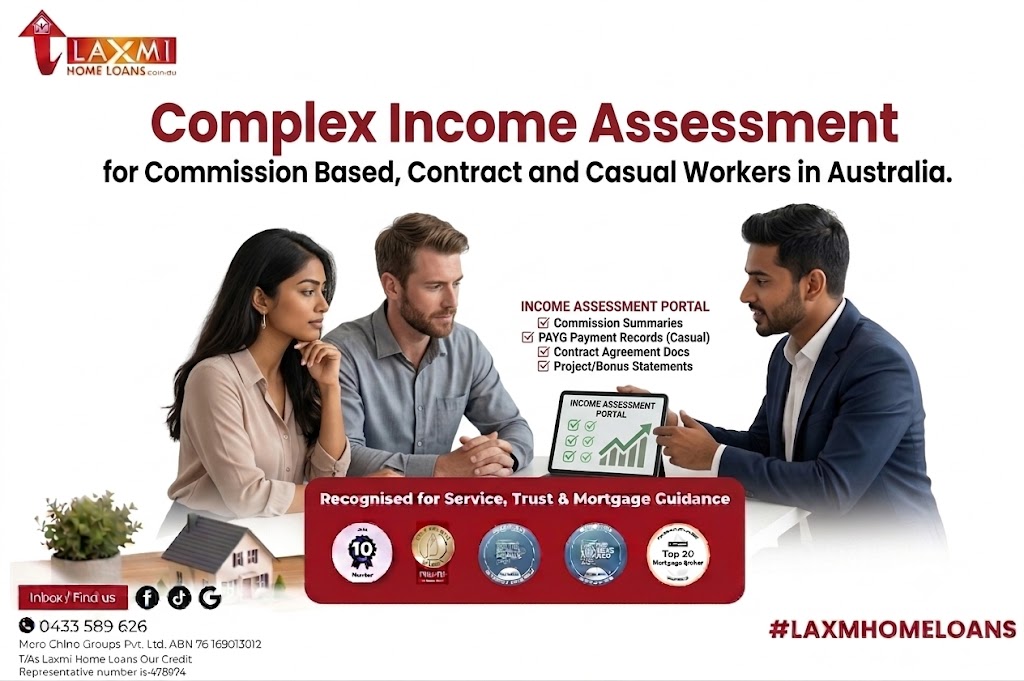
Home Loans for Commission, Contract and Casual Workers in Australia
If your income is not a fixed salary, getting a home loan can feel harder than it should be. Commission-based employees, contractors and casual workers can access home loans when the right lender and application structure are used.
Yes, commission-based, contract and casual workers can get a home loan in Australia. Lenders assess variable income differently from fixed salary, often by averaging income, applying shading percentages or requiring longer history. Borrowing capacity can vary significantly between lenders.
Priya works as a registered nurse across two casual positions at a Sydney hospital. Her fortnightly income is strong and consistent, but when she approached her bank directly, she was told her casual status made the application complicated.
That does not mean a home loan is out of reach. Many Australians with variable or non-standard income are approved every day. The issue is usually lender selection, not the income itself.
What Is a Complex Income Assessment?
A complex income assessment is the process lenders use when your earnings are not fixed or consistent throughout the year. Unlike borrowers who receive the same salary every fortnight, lenders need additional evidence that your income is stable and likely to continue.
Complex income is common across Australia. Lenders have established policies for assessing it, but those policies differ substantially between lenders.
Commission and Bonus Income
- Real estate agents
- Mortgage brokers
- Financial advisers
- Recruitment consultants
- Business development managers
- Car sales consultants
Contract and Fixed-Term Income
- IT contractors
- Engineers
- Mining and construction workers
- Healthcare professionals
- Government contractors
- Professional services consultants
Casual Employment
- Registered nurses and midwives
- Aged care and disability workers
- Teachers and university staff
- Hospitality and retail workers
- Warehouse and logistics staff
- Support workers
Other Variable Income
- Overtime and shift allowances
- FIFO workers
- Labour hire employees
- Multiple job holders
- Seasonal workers
- Rental income earners
Why Borrowing Capacity Varies Between Lenders
Your borrowing capacity is not a fixed number. It depends on which lender assesses your file and how that lender treats your specific income type.
| Income Type | More Flexible Lender Approach | More Conservative Lender Approach |
|---|---|---|
| Commission income | May accept one year history or average at 100% where history is strong. | May require two years and shade income to 80% or use the lower year. |
| Bonus income | May include if consistent and documented. | May require two full years or exclude if discretionary. |
| Casual employment | May accept after 6 months with consistent hours. | May require 12 to 24 months of history. |
| Contract income | May annualise current daily or hourly rate. | May require two years of contracting history. |
| Overtime | May include if regular and ongoing. | May shade or exclude overtime income. |
| Multiple jobs | May accept both eligible income sources. | May use only primary income or require longer history. |
The difference between lender policies can amount to a significant borrowing capacity gap. Read more in our guide: Why Does My Annualised Income Look Different Between Banks?
How Lenders Assess Commission and Bonus Income
Commission income is common across sales, finance, recruitment and real estate roles. Many lenders will assess commission if it has been received consistently and is supported by payslips, income statements and tax documents.
Some lenders average the last two financial years. Some use the lower year. Others shade the amount to account for variability. Bonus income is usually assessed more cautiously, especially where it is discretionary or one-off.
A business development manager had base salary plus commission. One lender assessed only the base salary. Other lenders accepted averaged commission income, producing a much stronger borrowing capacity outcome. Choosing the right lender made the difference.
How Lenders Assess Contract Workers
Contract workers are common in technology, engineering, healthcare, professional services and government roles. Lenders consider the length of contracting history, industry experience, remaining contract term, renewal history and gaps between contracts.
Some lenders may annualise your current daily or hourly rate where the income is stable and the contract history supports ongoing work.
How Lenders Assess Casual Workers
Casual employment is common across nursing, aged care, education, hospitality, retail and support work. Many casual workers earn reliable long-term income despite the casual employment classification.
Some lenders accept casual income after six months if hours are consistent. Others require twelve months or longer. Healthcare workers, such as nurses and midwives, may benefit from more favourable policies where income history is stable. Read more about LMI waivers for nurses and midwives.
What Happens If You Have Multiple Income Sources?
Many borrowers combine income from two casual jobs, salary plus commission, contract work and rental income, or overtime and allowances. Each income source may be assessed differently.
A broker can help identify lenders whose policies are most favourable to your specific combination of income types. For a starting estimate, use our borrowing capacity calculator.
How the Assessment Process Works
Employment stability review. Lenders review employment history, occupation demand, tenure and industry stability.
Document collection. Documents may include payslips, employment contracts, tax returns, income statements, notices of assessment and bank statements.
Assessable income calculation. Income may be averaged, annualised, shaded or based on the lower year depending on lender policy.
Serviceability assessment. The lender reviews your expenses, debts, dependants and repayment buffer.
Credit policy review. Final eligibility depends on the lender’s specific rules for employment type, income history and documentation.
Documents You Will Need
| Category | Documents Usually Required |
|---|---|
| Identity | Driver licence, passport or other ID documents. |
| Commission or bonus income | Recent payslips, income statements, employer letter, tax returns and notices of assessment. |
| Casual employment | Recent payslips, employment letter, year-to-date income summary and bank statements. |
| Contract income | Current contract, renewal history, tax returns, notices of assessment and bank statements. |
| Banking and savings | Three to six months of bank statements and savings history. |
| Existing liabilities | Statements for loans, credit cards, HECS-HELP or other debts. |
Incomplete documentation is one of the most common causes of delays for borrowers with complex income. Gather documents before a lender submission to reduce risk and improve turnaround time.
Common Challenges and How to Address Them
Short Employment History
A recent job change does not automatically mean the application will be declined. Some lenders focus more on industry experience than time with the current employer.
Income Fluctuations Between Years
Seasonal or performance-driven income may vary year to year. Providing longer income history and context can help lenders understand the pattern.
Gaps Between Contracts
Short gaps may be acceptable in industries where contracting is common. A written explanation and evidence of ongoing work history can support the application.
Multiple Income Sources
Each income source should be documented separately. Combining multiple income types without proper support may result in some income being excluded. Read our guide on how banks calculate borrowing power.
How to Strengthen Your Application
- Maintain stable employment. Avoid unnecessary job changes before applying where possible.
- Reduce existing debts. Lower credit card limits and personal loan balances where practical.
- Build genuine savings. Regular deposits over time can strengthen your application.
- Keep accurate records. Retain payslips, contracts, income statements and tax documents.
- Choose the right lender. Lender selection can have a major impact on borrowing capacity.
Frequently Asked Questions
Can I get a home loan if I work casually?
Yes. Many lenders accept casual income if you can demonstrate stable employment and consistent earnings. Required employment history varies between lenders.
Can commission income be included in my home loan assessment?
Usually, yes. Most lenders assess commission if it is consistent and supported by payslips, tax returns and income statements. The method varies between lenders.
How much employment history do I need?
This depends on income type and lender policy. Some casual workers may be assessed after six months, while commission and contract income may require longer history.
Can contract workers qualify for a home loan?
Yes. Contract workers can qualify where income is stable and supported by contract history, renewals and bank statements.
Do all lenders calculate borrowing power the same way?
No. Lender policies vary significantly, especially for variable income. Borrowing capacity can differ between lenders.
Should I apply directly to my bank or use a mortgage broker?
For complex income, using a broker can help because brokers compare lender policies before submitting an application.
What if I recently changed jobs?
A recent job change does not automatically disqualify you. Some lenders consider industry experience and continuity of income.
How is FIFO or shift allowance income treated?
FIFO income and shift allowances are usually treated as variable income. Some lenders include these amounts if they are consistent and documented.
Ready to Discuss Your Complex Income Home Loan?
If your income comes from commissions, casual shifts, contracts or multiple sources, speak with our team before approaching a lender. We assess your income across 50 plus lenders.
Related Guides
About Kishor Acharya and Laxmi Home Loans
Kishor Acharya is the Principal Broker and owner of Laxmi Home Loans. Laxmi Home Loans was founded in 2015 and has helped more than 1,000 families across Australia. The team compares options across 50 plus banks and lenders and provides guidance in English, Nepali and Hindi.
General information only. This article is for general information purposes only and does not constitute financial advice. Lending criteria, income assessment policies and product features vary between lenders and are subject to change. All lending is subject to lender assessment and eligibility criteria. Please consult a licensed mortgage broker for advice tailored to your individual circumstances. Laxmi Home Loans does not guarantee loan approval or borrowing capacity outcomes.
Mero Chino Groups Pty Ltd T/As Laxmi Home Loans | ABN 76 169 013 012 | Credit Representative Number 476974 | Authorised under Australian Credit Licence Number 383640